
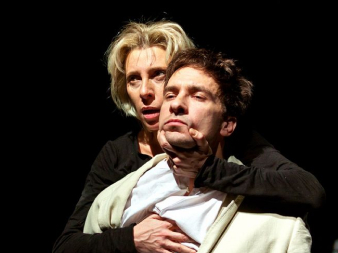
What motivated Jean Anouilh to turn to the tragedy by Euripides? On one hand – our time, when the impending threat of social fall is destroying the personality, the culture, the politics, on the other hand – an attempt to stay in denial craving for entertainment, show and feckless gaiety. The fact that society has no intention to examine its medical history scares, as xenophobia, racism and violence raise their heads. Against the backdrop of the disastrous fall of morality, cynicism, striving for wealth and the increasing power of money the man is gradually destructing. Only the strongest ones will manage to be unlike the others, to defend one’s independence and not to adjoin the stream of the philosophy of wealth, to reject the tempting postulate of “I am like all the others” and to realize that the faceless ruck is ruinous. Anouilh’s “Medea” descended from the Euripides’s buskin and became closer to us, the vocabulary of the play is modern. Dialogues of the heroes corkscrew from past to present and back to the past. The creators of the show tried to distinguish the meaning of the flows of words and actions.
Artist: VAKHTANGOV THEATRE
Crawfish cry
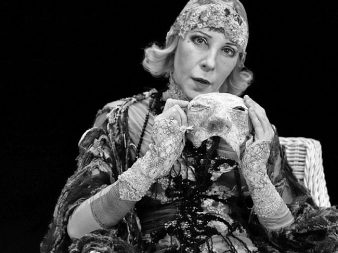
The great actress Sarah Bernhardt is trying to reconstruct events of the past. In her memories, she is on the stage again, in her childhood, immersed in the conflict with her mother, or in conversations with her lover. Why she needs it all? Yes, she needs it to fill her fading life with emotions and passions, but this time only in memories. She still needs the stage and partners. Sarah Bernhardt delivers monologues and has imaginary dialogues with her secretary Pitou.
Some important words remain unsaid, so Sara Bernhardt stubbornly continues her one-sided dispute with her late opponents. At the verge of nonexistence, her feelings, suffering, passions, irrationality all come back naturally. This is what life is all about, and what theater is about.
Eugene Onegin
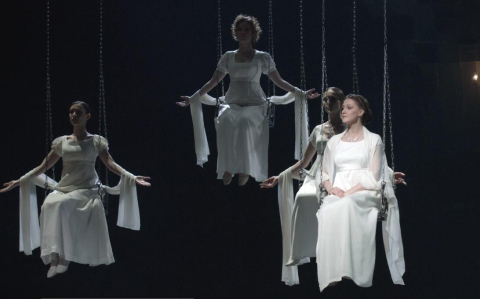
Rimas Tuminas in his production of “Eugene Onegin” does not aim at a full scenic adaptation of A.S. Pushkin’s novel in verse. For his main theme, he chooses a story of Tatyana’s love for Onegin, a story with prologue and epilogue. The performance unfolds in the memory and imagination of A.S.Pushkin’s characters. We are transferred from Onegin’s room into his country estate, then into the Larin’s house nearby, then to Moscow – and finally back to his room. The scale of events constantly changes: from noisy celebrations to secluded contemplation, from crowd scenes to lonely recollections, all of which are drawn together from the past just like the fragments of Tatyana’s love letter, framed and hung on the wall next to Onegin’s arm-chair.